Disclaimer
This is an excerpt from the world's first evidence-based acupuncture and herbal medicine menopause textbook: Menopause A Comprehensive Guide for Practitioners. Written by Katherine (Kath) Berry & Natalie Chandra Saunders, registered Chinese medicine practitioners with decades of experience, it is for educational purposes and does not replace personalized medical advice. If you are on medication, have a current diagnosis, or have concerns about your health, please consult your GP or specialist before starting any new treatment. Contact a qualified Acupuncturist / Herbalist for a full consultation and tailored treatment plan.
eBook (US spelling)
ISBN 978-1-7391-308-8-6
Copyright © Katherine Berry 2023
Menopause: More Than an Evolutionary Quirk?
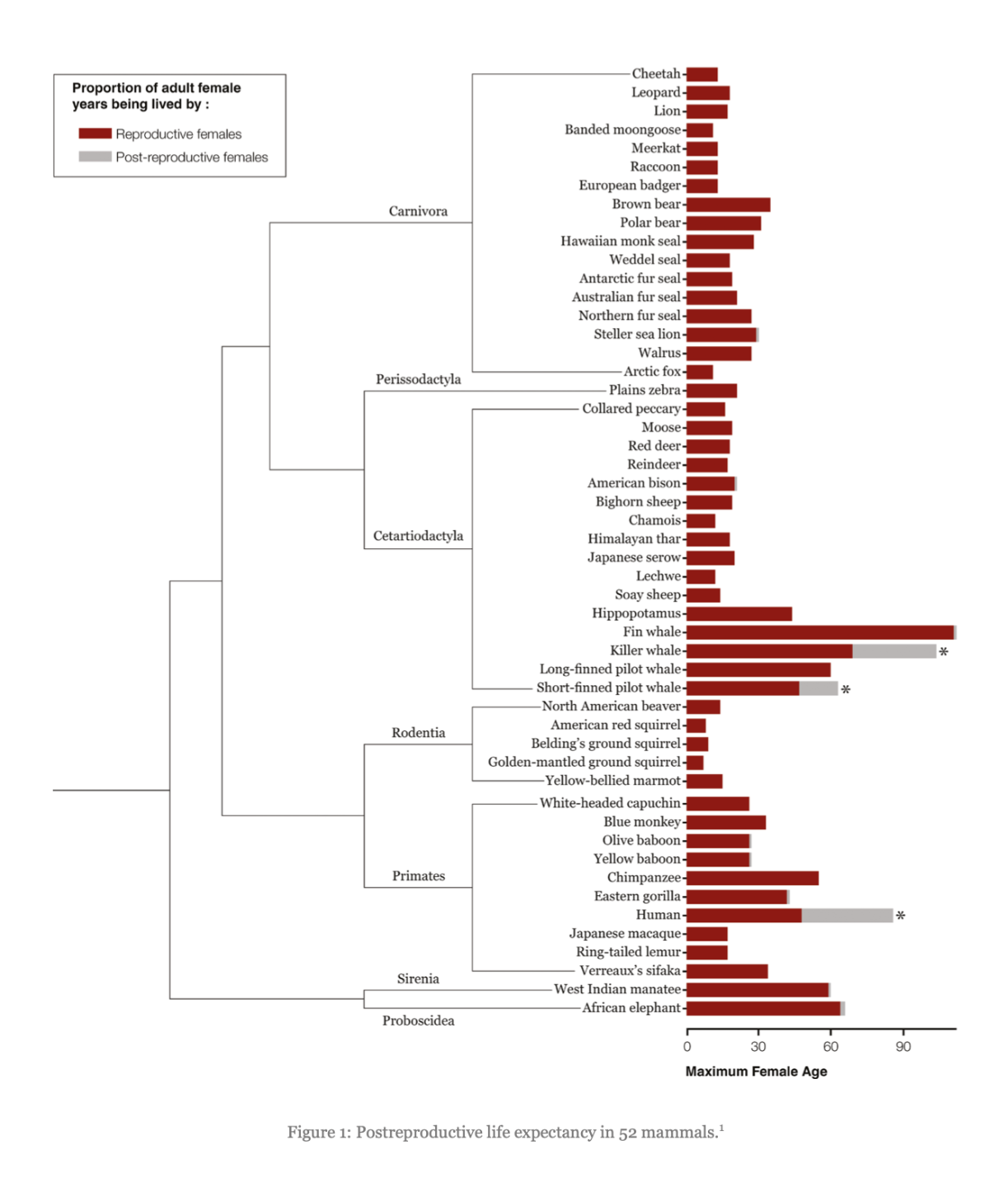
Menopause is unique to just a handful of species; humans (Homo sapiens) and several aquatic mammals, including killer whales (Orcinus orcas), short-finned pilot whales (Globicephala macrorhynchus), beluga whales (Delphinapterus leucas), and narwhals (Monodon monoceros). While these sea creatures may initially appear to have little in common with humans, they are social animals and tend to live in groups, known as pods. These pods can consist of several families which are, in many cases, matrilineally related.
Experts have suggested that menopause is an evolutionary phenomenon that increases the chances of a mother passing on her genetics. It enables her to devote more energy to the family or pod’s survival rather than continuing to reproduce.
Offspring born to older mothers have a lower survival rate than those born to younger individuals. Therefore, shutting off reproduction at middle age and assisting in the care of grandchildren preserves genetic lineage more efficiently than competing with younger descendants who are also reproducing.
This theory is known as the grandmother hypothesis of menopause. However, it is currently just that, a hypothesis. Although there is strong evidence to support it, some scientists argue that menopause is simply an evolutionary quirk that has persisted in our genes for no particular reason. However, if proven, the grandmother hypothesis would explain why humans and other species go through menopause, and why women’s life spans can extend far beyond the reproductive years.
The authors highlight this evolutionary biology theory as it underpins one of the central themes of this book: reframing menopause as a positive experience. In both humans and killer whales, older females support the survival, wellbeing, and reproduction of their offspring and grand-offspring. In humans, this extends to society as a whole, meaning that even women who do not have children of their own can make valuable contributions to future generations by sharing their experience, love, and wisdom.
Figure 1. Shows 52 species of mammals and their average female life expectancy. The red bar indicates the reproductive years and the gray bar shows the number of years survived on average, after the reproductive years. An asterisk (*) indicates the species where postreproductive years are significant in comparison to reproductive years (killer whales, short-finned pilot whales, and humans).
Reference:
1 Ellis S, Franks DW, Nattrass S, et al. (2018). Postreproductive lifespans are rare in mammals. Ecol Evol. 2018;8:2482–2494. https://onlinelibrary.wiley.com/doi/epdf/10.1002/ece3.3856